
One Index, Many Writers: Avoiding Git Merge Conflicts with Deterministic Write Areas
How a small structural change reduced unnecessary Git conflicts in a shared Markdown index — and made it easier for coding agents to navigate.
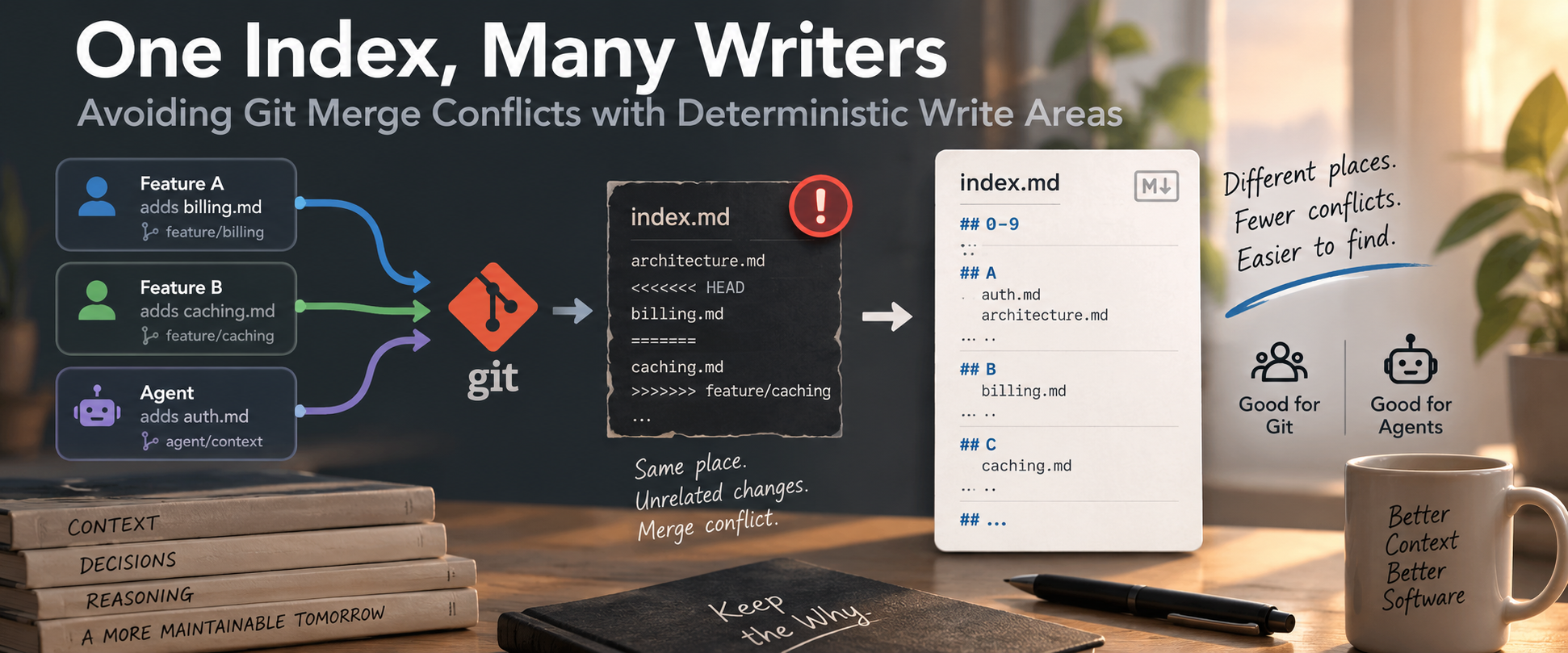
While working on Keep the Why, I ran into a very ordinary Git problem.
There is one shared context/index.md.
Developers and coding agents can add new context files in different branches. The changes are unrelated, but they are not written back to the repository at the same time. Git has to merge them later.
That is where things get interesting.
Imagine two branches.
One adds:
billing.md
Another adds:
caching.md
Both also update context/index.md.
If new entries are simply appended to the end of the file, both branches modify the same place.
Git sees overlapping changes.
Merge conflict.
The conflict is not semantic. Nobody disagrees about the content. It only exists because several writers use the same file and their changes are integrated later.
This came up in Keep the Why issue #194.
Alphabetical sorting helps, but not enough
My first thought was simple: stop appending new entries and keep the index alphabetically sorted.
That already spreads changes across the file.
But especially with a small index, it does not solve the problem.
Suppose the index contains only:
architecture
deployment
One branch adds:
billing
Another adds:
caching
Both additions belong between the same two existing lines.
So even though the entries are different and correctly sorted, Git can still see both branches changing the same area.
The interesting part is that this problem is actually worse while the index is still small.
With only a few existing entries, there are only a few natural places where Git can anchor an insertion. New entries therefore have a relatively high chance of landing in the same gap.
As the index grows, this usually improves by itself.
More existing entries create more separation points:
architecture
billing
caching
deployment
logging
monitoring
A new entry is now much more likely to land in its own area.
So the main problem is not a large index.
It is a sparse index with several delayed writers.
Creating the structure before it is needed
The solution I implemented is simple.
Every new index starts with fixed sections:
## 0
## 1
## 2
...
## 9

## A
## B
## C
...
## Z
All 36 sections exist from the beginning, even when they are empty.
A topic is inserted below the section matching the first character of its filename.
For example:
billing.md     -> B
caching.md     -> C
deployment.md  -> D
The important part is not really the alphabet.
The important part is that the write areas already exist before concurrent branches need them.
Instead of every new entry competing for one append position, changes are distributed across predefined parts of the file.
The headings become stable merge anchors.
In other words, the index gets some structure early instead of waiting for the content itself to create enough structure later.
A useful side effect for coding agents
The original problem came from Git.
But the fixed structure also makes the index nicer for agents.
An agent does not have to treat index.md as one unstructured Markdown block. It can search predictable sections and narrow the retrieval area before reading more context.
So the same structure gives two benefits:
Git gets stable places for independent changes to land.
Coding agents get predictable places to search.
That was not the original reason for the change, but it fits the way Keep the Why is supposed to work: simple, deterministic retrieval first, deeper reading only when necessary.
What I like about this solution
There is no database.
No locking.
No generated index.
No merge driver.
No additional service.
Just a little bit of structure added before it is actually needed.
The funny part is that once the index becomes larger, the entries themselves increasingly provide the separation Git needs. The fixed 0-9 and A-Z sections are mostly there to make the early and sparse state behave better.
It is a small change, but I like the general lesson behind it:
When many independent writers modify one Git-managed file, avoiding conflicts can be less about smarter merging and more about designing where changes are allowed to land.
I hope you found this informative and useful.
Follow me on GitHub, Bluesky, Mastodon, X, and LinkedIn, or join Telegram for updates on my latest publications. Constructive feedback is always appreciated.
Thank you for reading, and happy coding! ¯\_(ツ)_/¯
About the author
- I build systems that work — technically sound, security-first, and actually useful to the people who depend on them. Creator of the UNICORN Binance Suite — six open-source Python libraries with 3.3M+ downloads and 390+ dependent public projects — and Keep the Why, an open-source agent skill that preserves the reasoning behind engineering decisions alongside the code. Currently pioneering AI-driven open-source maintenance: running a controlled AI agent that maintains production code and documenting what this shift means for engineering teams. Vienna, Austria 🇦🇹
Comments
Join the discussionNice write-up, Oliver. The "sparse index with delayed writers" framing really clicked for me. It also explains why the headings work so well mechanically: Git's three-way merge conflicts on overlapping or even adjacent changes, and each heading guarantees at least one untouched line between write points.
One question: within a section, are new entries sorted, or inserted directly under the heading? With the latter, any two same-letter additions would still collide. That matters because first letters aren't evenly spread, especially for software topics (api, auth, cache, ci, config...), so C and S will probably run hot.
Also, since agents love to "tidy" files (removing empty headings, re-sorting, turning lists into tables), a small CI check that all 36 headings exist and each entry sits under the right one might be what keeps the convention alive long term.
Would love to see numbers on this at some point. git merge-tree --write-tree makes it pretty easy to simulate append vs. sorted vs. sectioned.
Great points.
Yes, entries are sorted by filename within each section. So two additions under the same letter can still collide if they land in the same gap - especially while that section is sparse. As it fills up, the existing entries themselves create more natural merge anchors. So the 36 headings don't eliminate conflicts, they mainly remove the worst case where every new entry competes for the same append position.
And funny enough, the “agents will tidy this away” problem is already covered too. The current spec + keep-the-why-lint check that all 36 headings exist, entries are under the correct heading, and entries are sorted (E205, E206, E204). I learned pretty quickly not to rely on an agent politely respecting formatting conventions. :)
I really like the git merge-tree --write-tree idea. A comparison of append vs. globally sorted vs. sectioned would be worth measuring - ideally also with a deliberately skewed filename distribution rather than uniform random data.
That might become a follow-up to the article. Thanks!
The interesting part is that this treats Git conflicts as a write-allocation problem, rather than trying to make the merge process smarter. Pre-allocating deterministic regions gives independent writers different merge anchors, which is especially useful when agents are making changes concurrently.
I also like the agent-retrieval side effect. Predictable sections reduce the search space before an agent has to load the actual context, so the same structure improves both merge behavior and retrieval efficiency. It’s a good example of a small repository convention solving what initially looks like two separate problems.
Exactly - that’s the part I found most interesting as well.
Once I stopped looking at it as a merge problem and started looking at it as a write-allocation problem, the solution became much simpler.
And yes, the retrieval benefit for agents was a nice side effect rather than the original goal. I like solutions where one bit of structure helps both humans/tools and Git without introducing another layer of infrastructure.
Thanks for putting it that clearly!
AI-Assisted Development
Real-world experiences with AI-assisted software development — what works, what breaks, where the limits are, and how AI changes development workflows in practice.